▸▸ Orange County, CA ONLINE
Daniel La Rocco
Physics Ph.D. · Scientific Software Developer
I build open-source simulation and modeling tools for particle physics: Monte Carlo frameworks, statistical inference, and the software that makes them usable.
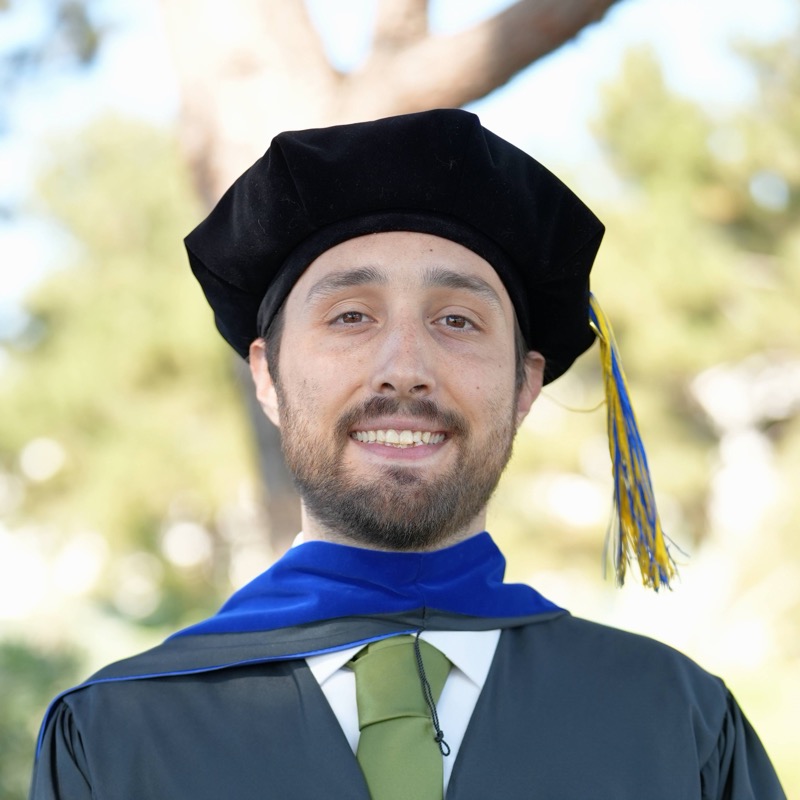
Physics PhD (UC Irvine, 2026) specializing in large-scale scientific simulation, statistical inference, and open-source scientific software. I build and maintain Python Monte Carlo and modeling tools used by research collaborations, with a track record of performance optimization, validated numerical methods, and clear technical communication across publications and invited talks.
GeV-Scale Neutrinos: Modeling, Discovery and Characterization at Forward Physics Experiments
My doctoral thesis develops the modeling, simulation, and statistical machinery to discover and characterize heavy neutral leptons at the LHC and fixed-target experiments.
[ + Show abstract ][ − Hide abstract ]
In this dissertation, we work through three aspects of MeV-to-GeV heavy neutral lepton (HNL) phenomenology relevant to the forward physics experiments at the LHC: modelling, discovery, and characterization. For modelling, we created HNLCalc, a public python library that computes HNL production and decay branching ratios for arbitrary coupling ratios |U_e|² : |U_μ|² : |U_τ|² across the MeV-to-GeV window. Paired with the companion HNL module we built for the FORESEE simulation package, the two together form an end-to-end pipeline for simulating general HNL coupling patterns at any forward-LHC experiment. For discovery, we use these tools to compute the sensitivity reach of FASER and FASER2 in the five Physics Beyond Colliders benchmark coupling patterns, including the mixed-flavor benchmarks (011 and 111) for which the simultaneous contribution of multiple couplings to the total HNL width reshapes event rates and kinematic distributions in ways that cannot be reconstructed by combining single-coupling results. For characterization, we assume that a Majorana HNL has been discovered and ask how precisely FASER2 can pin down its mass, coupling, and spinor nature through standalone FASER2 measurements of fully-visible N → μπ decays. Additionally, we propose the use of FASER2 as a trigger for ATLAS, the first proposal to use a far-forward detector as a hard trigger for a central LHC experiment. This sharpens Majorana-versus-Dirac discrimination by tagging events as lepton-number-conserving or lepton-number-violating from the charge of the lepton produced in association with the HNL and subsequently detected by ATLAS.
Select figures. Click one to enlarge.